Partial pooling across groups in a composed model
A multi-group epidemic is a panel: one shared infection process seen by several groups, each reporting it at its own level. GroupedIDModel expresses this panel as a composed model rather than a hand-written @model. It holds a shared infection process, a group_effect prior over the grouping axis, an observation model, and a combiner mapping a group's effect to its expected series.
This page drives a per-group reporting level with a Hierarchy inside a GroupedIDModel, simulates from it and fits it end-to-end under NUTS, recovering the per-group levels. The group dimension threads from the data and the group prior is namespaced by the component, so the panel composes with no hand-orchestration.
The composed model
The shared epidemic is a DirectInfections process carrying a RandomWalk latent, observed with a PoissonError. Every group sees the same infection curve Hierarchy, supplied as the group_effect.
using ComposableTuringIDModels, Distributions, Turing, Random, Statistics
using Turing: returned
Random.seed!(77)

idmodel = IDModel(
    DirectInfections(; Z = RandomWalk(), initialisation = Normal(log(50.0), 0.2)),
    PoissonError())
hierarchy = Hierarchy(; mean = Normal(0.0, 0.5), across = IID(Normal(0.0, 0.5)))
model = GroupedIDModel(idmodel, hierarchy)
GroupedIDModel
├─ infection: DirectInfections
│ └─ Z: RandomWalk
│ └─ ϵ_t: HierarchicalNormal
├─ group_effect: Hierarchy
│ └─ across: IID
└─ observation: PoissonErrorThe grouping dimension is not a field of any component. GroupedIDModel reads n_time and n_groups from the shape of the data matrix Y (rows are time, columns are groups) and passes n_groups to the Hierarchy and n_time to the infection process, the same way a series length is passed to as_turing_model(latent, n).
The group prior carries its own innovations (the IID across process samples an ϵ_t), which under the prefix-off submodel convention would collide with the infection RandomWalk's own ϵ_t. GroupedIDModel namespaces the group prior through the prior-slot prefix convention so the two never collide, and prefixes each group's observation with group<g>. The mapping from a group's effect to its expected series is the combiner field. Its default is a multiplicative effect on the exponential scale, exp(ℓ_g) scales the shared curve. Swap combiner for a different mapping the way Ascertainment swaps its transform.
Simulate
Passing an all-missing matrix makes the model a prior simulator; the group dimension threads from its column count. We simulate eight groups over 24 time steps:
n_time, n_groups = 24, 8
Ymiss = Matrix{Union{Missing, Float64}}(missing, n_time, n_groups)
sim = as_turing_model(model, Ymiss)()
Ydata = reduce(hcat, [Int.(sim.y[g].y_t) for g in 1:n_groups])
true_levels = sim.group_levels
(n_time = n_time, n_groups = n_groups, data_size = size(Ydata),
    true_levels = round.(true_levels, digits = 2))
(n_time = 24, n_groups = 8, data_size = (24, 8), true_levels = [0.03, 0.64, -1.05, -0.14, -0.41, -0.36, 0.13, -0.27])The shared infection curve is common to all groups; the columns of Ydata differ only through the per-group level and Poisson noise.
Fit
Conditioning on the simulated counts and sampling with NUTS recovers the posterior end-to-end. n_groups again threads from the data matrix, so nothing about the group dimension is hard-coded in the components:
posterior = as_turing_model(model, Float64.(Ydata))
chain = sample(posterior, NUTS(0.85; adtype = Turing.AutoForwardDiff()), 300;
    progress = false)
size(chain, 1)300The per-group levels are a generated quantity, recovered per draw with returned and compared with the simulated truth:
level_draws = reduce(hcat, [g.group_levels for g in vec(returned(posterior, chain))])
post_mean = vec(mean(level_draws; dims = 2))
(true_levels = round.(true_levels, digits = 2),
    posterior_means = round.(post_mean, digits = 2),
    correlation = round(cor(true_levels, post_mean), digits = 3))
(true_levels = [0.03, 0.64, -1.05, -0.14, -0.41, -0.36, 0.13, -0.27], posterior_means = [0.01, 0.63, -1.1, -0.23, -0.47, -0.48, 0.06, -0.26], correlation = 0.996)The posterior per-group levels line up with the simulated truth. A plot with 80% credible intervals against the
using CairoMakie
qs = [quantile(level_draws[g, :], [0.1, 0.5, 0.9]) for g in 1:n_groups]
lo = getindex.(qs, 1)
md = getindex.(qs, 2)
hi = getindex.(qs, 3)

fig = Figure(; size = (620, 460))
ax = Axis(fig[1, 1]; xlabel = "True group level ℓ_g",
    ylabel = "Posterior level ℓ_g")
lims = (minimum(true_levels) - 0.4, maximum(true_levels) + 0.4)
lines!(ax, [lims...], [lims...]; color = :grey, linestyle = :dash)
rangebars!(ax, true_levels, lo, hi; color = :seagreen, whiskerwidth = 10)
scatter!(ax, true_levels, md; color = :seagreen, markersize = 12)
fig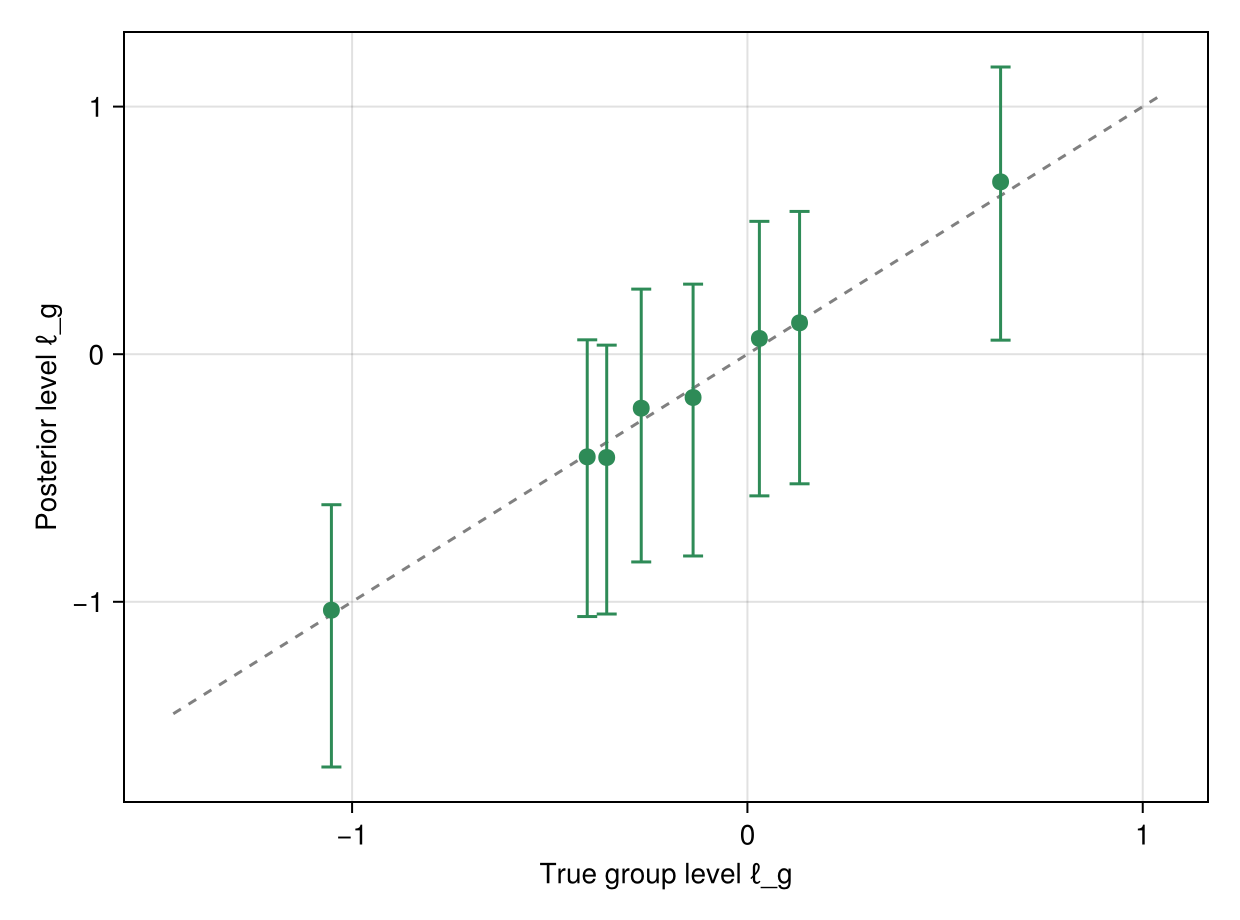
Each group's credible interval covers the GroupedIDModel supplied the panel structure, the Hierarchy supplied the per-group levels, and the group dimension threaded from the data with the group prior namespaced by the component. Swapping across = RandomWalk() in the Hierarchy would instead pool neighbouring groups (correlated ordered strata), and swapping the group_effect for a bare IID or a Distribution would drop the shared level for independent per-group levels, each with no other change.